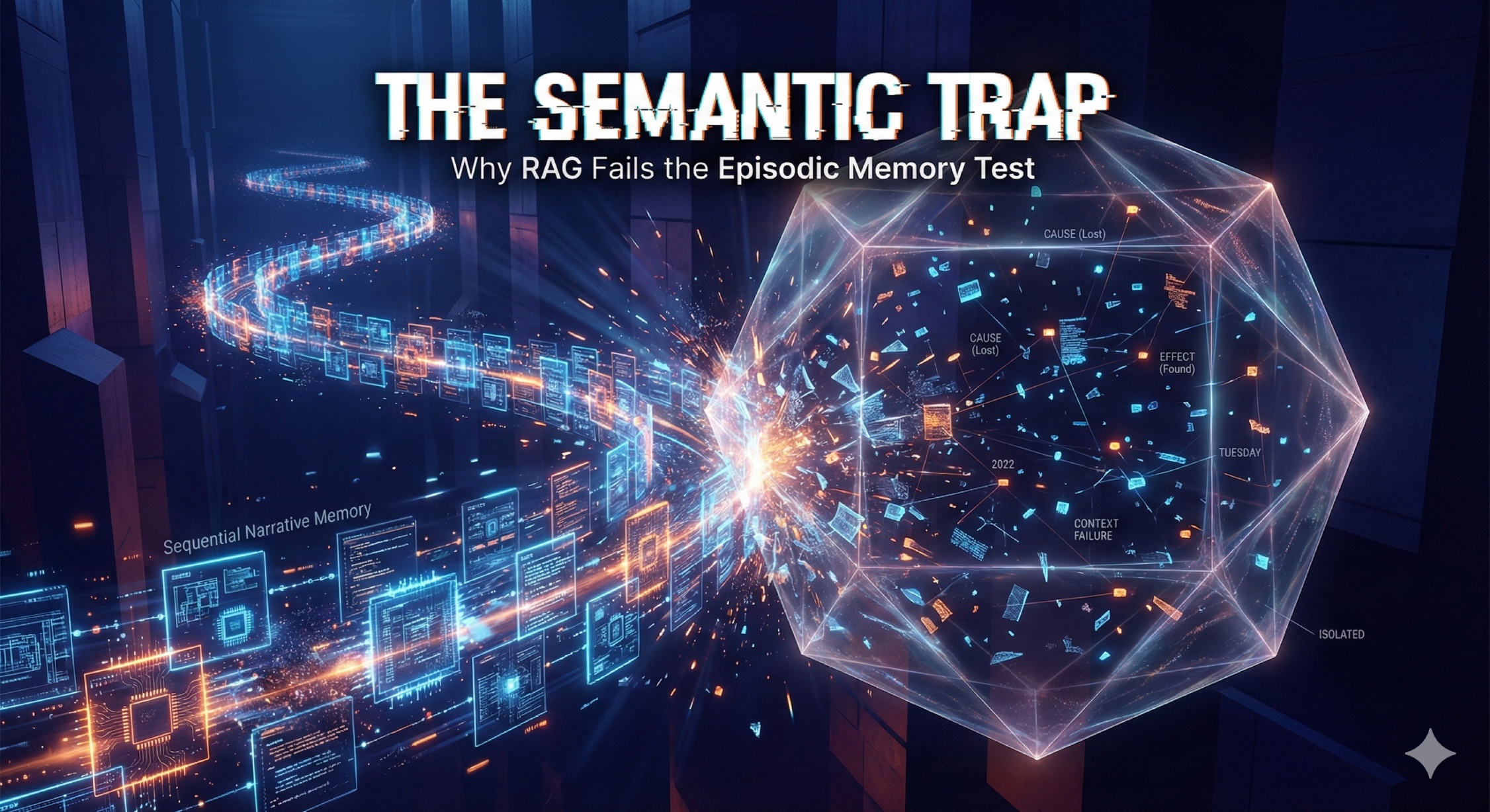
The Semantic Trap: Why RAG is Failing the Episodic Memory Test
Why standard RAG fails at episodic memory: A deep dive into the "Goldfish Problem", the limits of semantic similarity, and the loss of causal context in AI architectures.
In 20+ years, I’ve watched the industry cycle through various "silver bullets" for data retrieval—from the rigid hierarchies of relational databases to the sprawling chaos of NoSQL, and now, to the high-dimensional latent spaces of Vector Databases.
Today, Retrieval Augmented Generation (RAG) is the industry standard for giving LLMs a "brain." By coupling a generative model with a vector store like Pinecone or Milvus, we’ve supposedly solved the context window problem.
But as we move from simple Q&A bots to autonomous agents, we are hitting a wall that semantic similarity cannot climb. I call it The Semantic Trap, and it’s creating a generation of AI that suffers from what is colloquially known as the Goldfish Problem.
The Illusion of Proximity
To understand the failure, we have to look at the foundation. RAG operates on the principle of semantic similarity. We take a chunk of text, pass it through an embedding model, and turn it into a high-dimensional vector. When a user asks a question, we calculate the distance (often via cosine similarity) between the query vector and our stored vectors.
On paper, this is elegant. In practice, it’s a flat representation of a multi-dimensional reality. The "trap" is the assumption that semantic closeness equals logical relevance.
The Goldfish Problem: Episodic vs. Static Memory
Standard RAG is excellent for static knowledge retrieval. If you ask, "What is the company's policy on remote work?" a vector search will successfully pull the policy document. The semantics are clear and the information is evergreen.
However, RAG fails catastrophically at episodic memory—the ability to recall specific events, their sequence, and their causal relationships.
Imagine a user asking an AI agent: "Why did we decide to move the product launch to October?"
A traditional RAG system will query the vector database for "product launch," "October," and "decision." It might return:
A Slack thread from last Tuesday discussing the move to October.
A brainstorming session from six months ago where October was mentioned as a "maybe."
A project plan from last year for a completely different product that also launched in October.
The vector database sees three "close" matches. What it doesn't see is the Temporal Hierarchy. It cannot distinguish between the cause (a supply chain delay mentioned in a separate, non-semantically-similar thread) and the effect (the decision to move the date).
The Loss of Sequence and "Islands of Meaning"
The fundamental architectural flaw of vector stores is that they flatten time. When we chunk data for RAG, we break a narrative into "islands of meaning." We sever the connective tissue—the "then," the "because," and the "therefore."
The Narrative Thread: In human memory, we store information as a sequence. Event A led to Event B, which necessitated Decision C.
The Vector Reality: In a vector store, Event A, Event B, and Decision C are just floating points in a 1536-dimensional void.
Because standard RAG retrieves the top k most similar chunks, it often misses the "bridge" chunks—those pieces of data that aren't semantically rich themselves but provide the causal link between two important events. This leads to agents that "stutter," repeating questions they’ve already asked or losing the thread of a complex, multi-week task.
The Relational Gap
We are currently witnessing a "Relational Gap" in AI development. Vector retrieval optimizes for matching, but human intelligence relies on understanding relations.
Current evaluations of RAG systems show that as the complexity of the task increases—specifically tasks requiring multi-hop reasoning or longitudinal context—the performance of simple vector retrieval decays exponentially. We are trying to build complex reasoning engines on top of a retrieval layer that doesn't understand the difference between yesterday and three years ago.
Moving Beyond the Vector
If we want to solve the Goldfish Problem, we have to stop treating memory as a search problem and start treating it as a topological problem.
We need architectures that respect the arrow of time and the weight of causality. Whether that involves GraphRAG (integrating knowledge graphs with vectors), hybrid temporal-lexical indexing, or entirely new ways of maintaining state, one thing is certain:
Semantic similarity is a poor proxy for a functioning mind.
As engineers, we need to stop marveling at the fact that the AI can find "related" text and start asking why it can’t remember the story we’ve been telling it for the last six months.