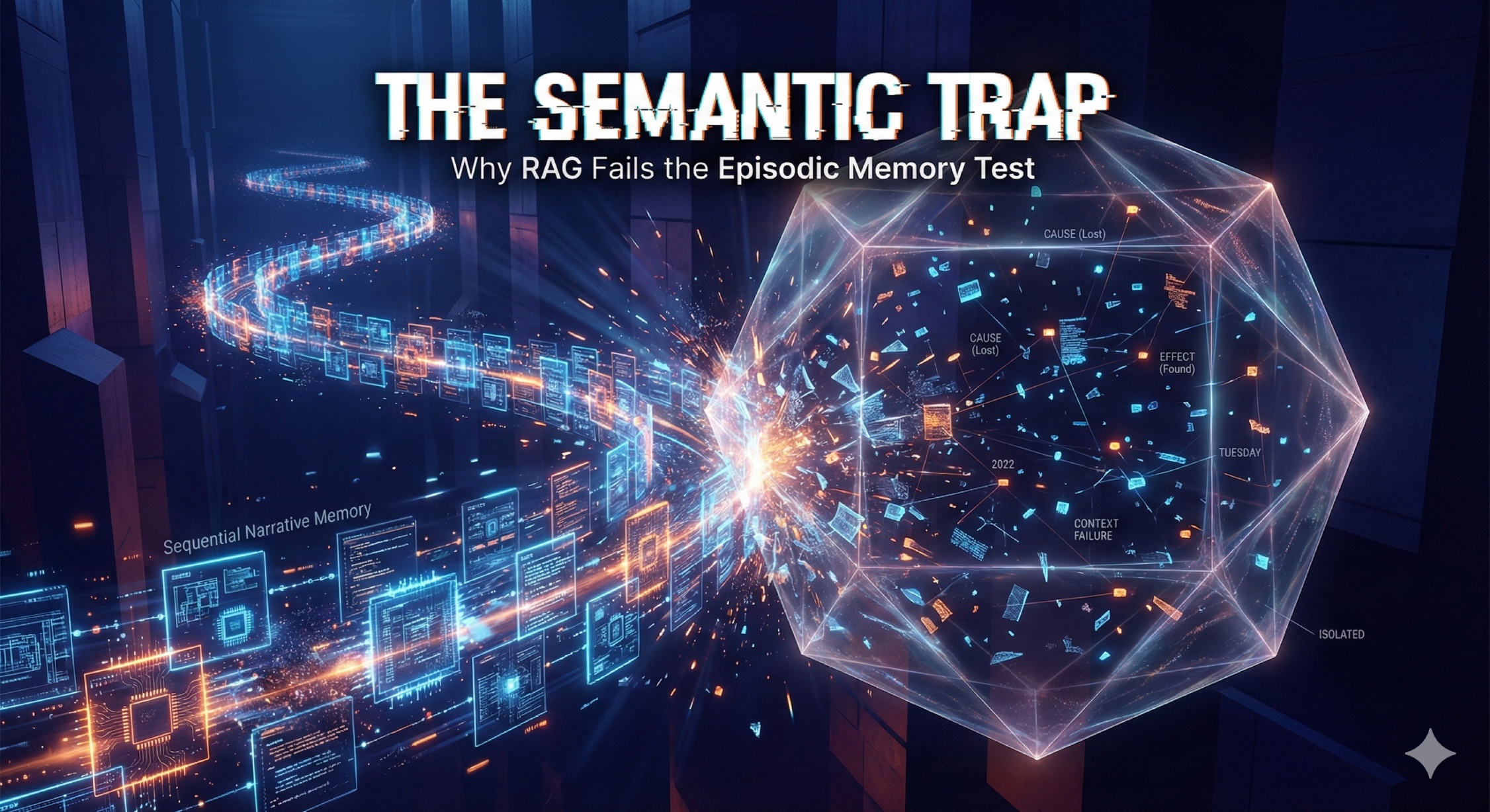
The Semantic Trap: Why RAG is Failing the Episodic Memory Test
Why standard RAG fails at episodic memory: A deep dive into the "Goldfish Problem", the limits of semantic similarity, and the loss of causal context in AI architectures.
Engineer by trade. Founder by choice. (Father by love.)

Why standard RAG fails at episodic memory: A deep dive into the "Goldfish Problem", the limits of semantic similarity, and the loss of causal context in AI architectures.

A lot of developers think AI replaces coding, but real software engineering is everything that happens after deploy—latency, load balancing, observability, data performance, cost, and security. This article explains why “vibe coding” with AI isn’t enough and why production engineering skills still matter if you want to ship reliable, scalable products.

This article argues that traditional, pre-defined software interfaces are becoming obsolete and will be replaced by adaptive, generative UIs that assemble just-in-time around user intent and data. It explores how data-first models, LLM-driven UI generation, and disposable micro-tools will transform how engineers design applications and how users experience software.

This article argues that AI-powered “vibe coding” and zero-marginal-cost app creation are killing traditional micro-SaaS, turning simple CRUD tools and AI wrappers into disposable commodities. It explains why the real defensibility now lies in deep integration, systems of record, regulation-heavy domains, and building complex, durable software instead of quick-fix tools.

Discover why the shift from “god prompts” to agentic AI mirrors the evolution from monoliths to microservices, and how distributed systems principles like decomposition, observability, and resilience now define scalable AI architectures. This article breaks down the technical patterns behind multi-agent systems and explains why systems engineers are becoming the new architects of intelligence.